

What is Speech, Language and Communication (SLC)?

Communication is a two-way process that enables individuals to interact and express thoughts, needs, and emotions. Speech refers to the sounds we use to form words. Language is the system of words and rules we use to convey meaning.
Communication encompasses both, including non-verbal cues like gestures and facial expressions.
Speech, language and communication (SLC) skills begin developing from birth. The early years are a critical window for SLC development.
Children learn through everyday interactions with caregivers and their environment. Loving, responsive relationships are key to fostering these skills.
Children develop at different rates. Milestones vary, and some children may take longer to reach them.
Remember children do not always develop at the same time and in the same way. This guide describes how a child might develop speech, language and communication at different ages.
Introduction
Health visitors and family nurses play a key role in prevention, early identification and intervention for children through the early years of their lives in relation to speech, language and communication. Understanding factors which can contribute to poorer and better outcomes can help in providing early, preventative support. This resource recognises the vital role of health visitors and family nurses in their ability to support families in relation to early speech, language and communication development.
Developed by Public Services Delivery Scotland, (formerly NHS Education for Scotland), to support the learning experiences of health visitors and family nurses in relation to speech, language and communication development. This resource is intended to complement wider learning experiences and signpost to relevant resources and further learning opportunities.
Background
This resource aims to guide health visitors and family nurses in the delivery of their named person and public health roles to children and their families in relation to speech, language and communication development. Using the principles of Getting it Right for Every Child (GIRFEC) and the Universal Health Visiting Pathway (Scottish Government, 2015) this resource aims to support health visitors and family nurses develop the skills and competence to work effectively in meeting the speech, language and communication needs of young children and their families.
GIRFEC My World Triangle and SLC – National Early Language and Communication Project - Health Visitors have a unique opportunity to prevent and intervene early to support SLC development and improve the life chances of Scotland’s children. Using the My World Triangle, alongside an awareness of protective and risk factors, gives practitioners a familiar framework to consider prevention opportunities based on risk for SLC concerns.
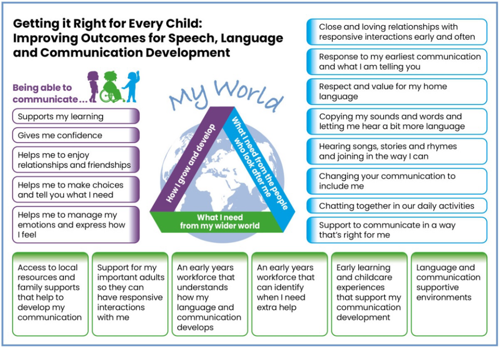
Who is the resource for?
This resource has been developed for use by health visitors and family nurses in Scotland and acts as a guide from pre-birth to five years. It may also be of use to other professionals working with young children and their families. The Universal Pathway for Health Visiting is referred to within the resource as the key points of contact with children and their families. This resource is intended for use to develop and extend the skills of both student learners and those who are seeking opportunities for continued professional development.
Learning Outcomes

On completion of the resource (and undertaking other learning signposted in the resources) learners will be able to:
Examine typical speech, language and communication development in children aged 0-5 years, recognise atypical speech, language and communication development and when there is a speech, language and communication need.
Appraise factors impacting on the speech, language and communication development of children and protective factors.
Interpret factors which can lead to poorer and better language outcomes which may indicate a need for enhanced caregiver support.
Evaluate strategies to empower parents/carers to promote speech, language and communication development in children aged 0-5 years and to signpost to other services.
Advocate for their own role, and that of others, in promoting speech, language and communication development in children aged 0-5 years.
Speech, Language and Communication development
The sections below are often used to highlight all the skills that children develop in order to communicate effectively. The skills below act as a foundation for more complex skills to develop. All these elements are important for children to communicate effectively. Each of these areas are multifaceted and multi-layered. Without aspects of any one of these elements, a child’s ability to communicate can be affected.
Click on each area to find out more about these skills.
Speech refers to the sound’s children use to build up words, saying sounds accurately and in the right places. Children learn speech sounds by listening to the sounds they hear in languages around them. In each language there is a developmental order in which children typically develop sounds (See attached Speech Sound Development guide). Children develop their use of speech sounds over time. It is a gradual process and some children will progress more quickly than others.
Speech can also refer to the ability to speak fluently, without hesitating, prolonging or repeating words or sounds. Speaking with expression and a clear voice, using pitch, volume and intonation to support meaning.
*See speech sound development guide
Expressive language refers to a child’s ability to express their needs and wants. This includes having words to describe objects, actions and attributes. It is using these words to build sentences, conversations and narratives. It also refers to the ability to use the correct rules of grammar.
It is important to consider all means a child uses to express themselves, including any non-verbal communication such as gestures, pointing or the use of any alternative/augmentative communication i.e. use of pictures, signs, communication books or high-tech communication aids.
A child requires both opportunities in their environment to expressive themselves as well as reasons (a purpose) to communicate i.e. to express a choice, share their opinion etc.
This refers to understanding of language. It is the ability to process and make sense of what people say. It is also how a child develops the understanding of non-verbal behaviours and gestures. Children develop their understanding of words and how to interpret the meaning of grammar. Receptive language also includes the ability to follow instructions, understand concepts such as ‘on’ and ‘in’ and to interpret questions. A child’s receptive language skills are typically developed in advance of their expressive skills. As children grow, they develop skills in their ability to reason, predict, draw inference and comparisons.
Children learn to communicate by interacting with others. Recognising and responding to a child’s early attempts at communication are important as this re-enforces the value of communication. By interacting with others, children learn the non-verbal rules of communication such as listening, looking and knowing how to take verbal turns. Children learn how to initiate interactions with others and take simple turns in an interaction. As children grow older, they continue to learn through interacting with others. They being to learn how to change their language use to suit a given situation and to take into account other people’s perspectives and intentions.
Play allows children to learn about the world around them. Learning through play is vital for the development of a child’s communication skills. Children need to have a variety of experiences to help them explore their world and practise skills which are important for learning, such as sharing and taking turns. There are several types of play which a child will learn gradually as he develops. In the second year of life children begin to engage in pretend play and then go on to develop more imaginative play. Pretend play is an important stage in supporting language development and often includes interaction with other adults and children.
Attention and listening skills are important for children to be able to make sense of words they hear, to respond to others and learn new skills such as developing their language skills.
Children progress through stages of attention and listening development. They gradually learn how to focus on more than one task and shift their attention to and from tasks.
Joint attention is one of the main building blocks for early interaction. Joint attention develops within the first year of life and is the basis of the development of effective communication skills. Joint attention is when the child responds to another person’s focus of attention or seeks an other’s attention to share an interest or experience.